

If you are considering dermal filler for the first time, one of your biggest questions may be: Are dermal fillers permanent?
For most fillers, the answer is no, and that can actually be a benefit. Most FDA-approved dermal fillers are made with materials that the body gradually breaks down and absorbs over time. How long your results last depends on the type of filler used, where it is placed, your individual metabolism, and other factors.
At Thrive Medical Spa, we believe filler should enhance and restore rather than alter. Our approach to dermal filler in Cincinnati focuses on thoughtful placement, facial balance, and results that complement your natural features.
Key Takeaways
Most dermal fillers are temporary, with results typically lasting anywhere from 6 months to 2 years, depending on the filler type, treatment area, and individual factors.
Temporary fillers offer greater flexibility, allowing providers to adjust treatments as your facial anatomy and aesthetic goals change over time. Certain hyaluronic acid fillers can also be dissolved.
Choosing the right dermal filler involves more than longevity. Product safety, proper placement, and personalized treatment plans are essential for achieving natural-looking results.
The Short Answer: Are Dermal Fillers Permanent?
Most Dermal Fillers Are Temporary
Most dermal fillers used today are considered temporary or absorbable. The FDA identifies hyaluronic acid (HA), calcium hydroxylapatite (CaHA), and poly-L-lactic acid (PLLA) as absorbable filler materials. PMMA is a non-absorbable material used in one type of FDA-approved permanent filler.
At Thrive, our traditional facial filler treatments utilize hyaluronic acid fillers, including products within the Juvéderm and Restylane portfolios.
Why Temporary Fillers Are the Most Popular Choice
One major advantage of temporary fillers is flexibility. Your face naturally changes over time, and a treatment plan that complements your features today may need to evolve in the future.
Temporary fillers allow providers to adapt placement and volume as facial anatomy, aging patterns, and aesthetic preferences change. With certain HA fillers, there is also the option to use hyaluronidase to reduce or dissolve the product when medically or aesthetically appropriate.
How Long Do Dermal Fillers Last?
There isn't one universal timeline. Filler longevity depends on the product, treatment area, amount injected, individual anatomy, and other patient-specific factors.
Average Longevity by Treatment Area
In practice, areas with significant movement, such as the lips, may require maintenance sooner than some more structural areas of the face. Cheeks, chin, and jawline may retain visible correction longer depending on the product selected and the individual patient.
These timelines should always be considered estimates rather than guarantees. The FDA notes that duration depends on both the filler material and the area in which it is injected.
Average Longevity by Filler Type
According to the FDA, hyaluronic acid fillers generally produce effects lasting approximately 6–12 months, while calcium hydroxylapatite effects may last approximately 18 months. PLLA can produce effects lasting up to two years. Individual products may have different FDA-supported duration data, so your provider should discuss expectations for the specific product being considered.
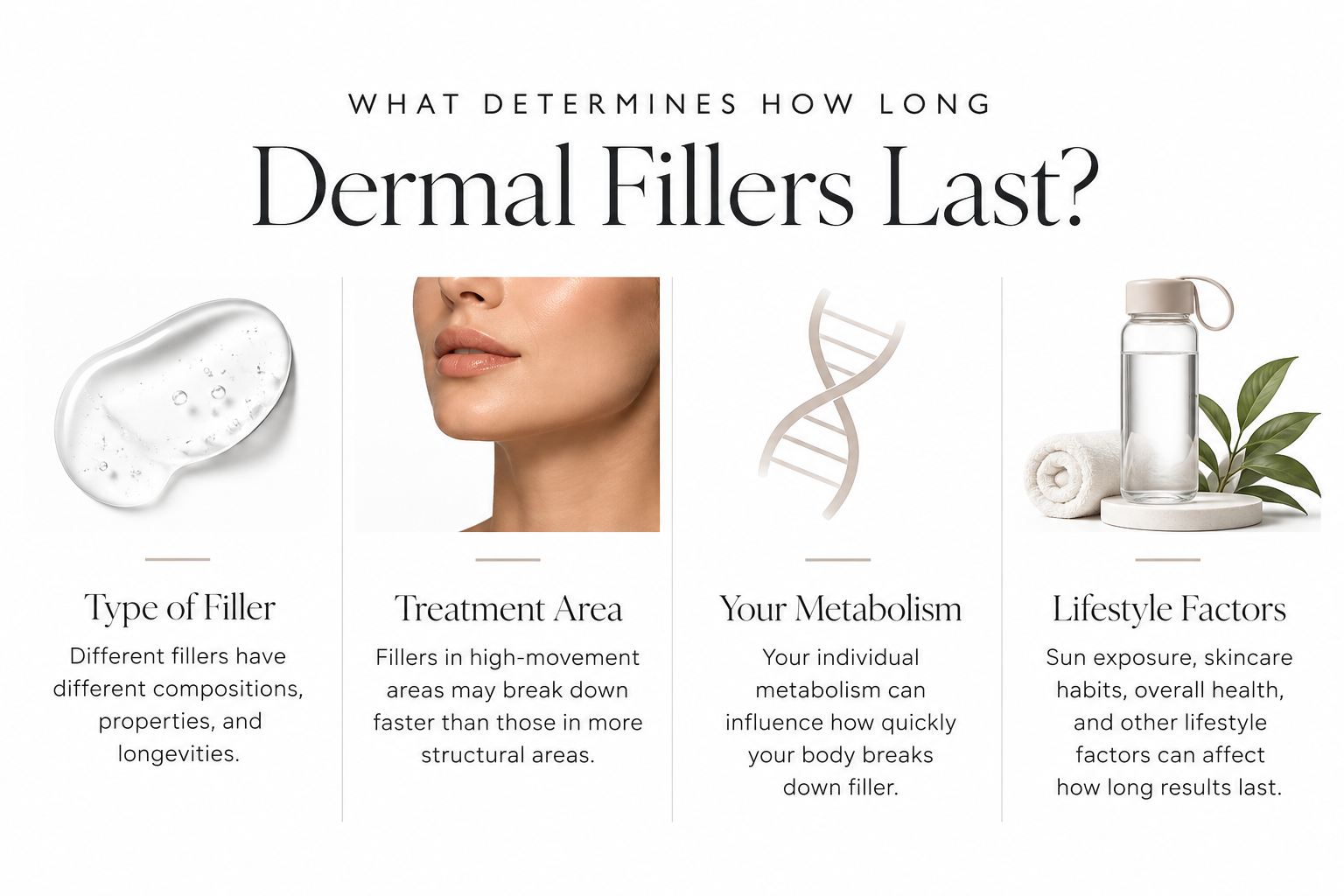
What Determines How Long Dermal Fillers Last?
Type of Filler
Different fillers have different compositions, properties, and intended uses. Even within the HA category, products vary in their formulation and characteristics. Your provider may select different fillers depending on whether the goal is restoring cheek volume, enhancing lips, defining the chin, or addressing another concern.
Treatment Area
Where filler is placed can influence how long its effects remain noticeable. Highly mobile areas may behave differently from areas where filler is being used primarily for structural support.
Your Metabolism
Individual biology also plays a role. Because absorbable fillers are gradually broken down by the body, the rate at which visible correction changes can vary from patient to patient.
Lifestyle Factors
Overall health, skincare habits, sun exposure, and other lifestyle factors can influence how your skin ages and how your results appear over time. Rather than focusing solely on making filler “last,” we encourage patients to think about comprehensive skin health and facial rejuvenation.
Are There Permanent Dermal Fillers?
What Are Permanent Fillers?
Yes, permanent dermal fillers exist. The FDA notes that there is currently one FDA-approved dermal filler made from a material that is not absorbed by the body. It contains polymethylmethacrylate (PMMA) microspheres, which remain within the tissue.
Permanent fillers also have more limited FDA-approved aesthetic indications than absorbable fillers.
Why Most Providers Prefer Temporary Fillers
A significant consideration with permanent filler is that it can be difficult, or sometimes impossible, to remove completely. Temporary fillers offer greater flexibility as a patient's anatomy and aesthetic goals evolve.
The FDA specifically advises patients that removing filler may require injections, surgery, or other interventions and that removing permanent or non-HA filler can be particularly difficult.
Temporary vs. Semi-Permanent vs. Permanent Fillers
The terms can become confusing, but fillers are often discussed according to how long their effects persist.
Hyaluronic acid (HA): Absorbable and temporary. HA fillers are widely used to restore volume and enhance areas such as the cheeks, lips, and chin.
Calcium hydroxylapatite (CaHA): Absorbable but generally longer-lasting than many HA fillers, with effects the FDA describes as lasting approximately 18 months.
Poly-L-lactic acid (PLLA): A biodegradable synthetic material that works gradually and can produce effects lasting up to approximately two years.
Polymethylmethacrylate (PMMA): Non-biodegradable and considered permanent because the PMMA microspheres are not absorbed by the body.
“Long-lasting” and “permanent” aren't interchangeable, which is why understanding the specific product being recommended is important.
Can Dermal Fillers Be Dissolved?
Which Fillers Can Be Reversed?
Certain hyaluronic acid fillers can be dissolved with hyaluronidase. However, not every filler can simply be dissolved. Non-HA products require different management, and permanent filler may be particularly difficult to remove.
How Hyaluronidase Works
Hyaluronidase is an enzyme used to break down hyaluronic acid. When clinically appropriate, an experienced healthcare provider may use it to reduce or dissolve HA filler.
Having filler dissolved is still a medical procedure and should be evaluated and performed by a qualified healthcare professional.
Do Dermal Fillers Eventually Leave Your Body?
Most FDA-approved fillers are made from absorbable materials, meaning the body gradually breaks them down over time. As this occurs, the visible effects of the treatment gradually diminish.
That doesn't mean your face suddenly changes when filler reaches a particular age. Instead, results generally evolve gradually, and patients can decide with their provider whether and when additional treatment is appropriate.
Can You Make Dermal Fillers Last Longer?
There is no reliable way to make filler permanent, but taking good care of yourself and your skin can support your overall results.
Follow Your Aftercare Instructions
Follow the specific post-treatment instructions provided by your injector. Some swelling, tenderness, redness, or bruising can occur after filler and commonly improves over the following days to weeks.
Maintain a Healthy Lifestyle
Daily sunscreen, quality skincare, hydration, balanced nutrition, and avoiding smoking are valuable for overall skin health and healthy aging, even though they cannot prevent filler from eventually being metabolized.
Schedule Touch-Up Treatments
Rather than automatically retreating according to a calendar, we recommend reassessing your face over time. Your provider can determine whether additional filler is appropriate based on your current anatomy, remaining correction, and goals.
Are Temporary Fillers Better Than Permanent Fillers?
There isn't one filler that is best for every person. However, temporary fillers offer several advantages, particularly the ability to adjust a treatment plan as the face naturally changes over time.
HA fillers also offer an additional layer of flexibility because they can potentially be dissolved when clinically appropriate. Permanent fillers remain in the body and can be more difficult to remove if a complication or undesired result occurs.
At Thrive, we believe the goal shouldn't be finding the filler that simply lasts the longest. It should be selecting an appropriate product, placement, and amount for your anatomy and desired outcome.
Final Thoughts: Choosing the Right Dermal Filler for You
So, are dermal fillers permanent? Most aren't, and for many patients, that's one of their advantages.
Modern temporary fillers allow an experienced injector to restore volume, enhance facial contours, and create greater harmony while retaining the flexibility to adjust your treatment plan as your face changes.
Dermal filler is also a medical procedure with potential risks, including uncommon but serious complications such as accidental injection into a blood vessel. The FDA recommends choosing a licensed healthcare provider who understands facial anatomy, injection technique, product selection, and complication management.
At Thrive, our philosophy is simple: enhance and restore, never alter.
Looking for Long-Lasting, Natural-Looking Dermal Fillers? Schedule Your Cincinnati Consultation Today.
If you're considering dermal fillers in Cincinnati, the best place to begin is with a personalized consultation.
At Thrive Medical Spa, we use trusted hyaluronic acid fillers from the Juvéderm and Restylane portfolios to address areas including the lips, cheeks, chin, jawline, smile lines, and other appropriate treatment areas. Your treatment plan is customized around your facial anatomy, concerns, and aesthetic goals, not a predetermined number of syringes.
Thrive welcomes patients to begin with a complimentary consultation at our Mariemont location at 7257 Wooster Pike in Cincinnati.
About Thrive Medical Spa
Thrive Medical Spa is a Cincinnati medical spa focused on natural aesthetic enhancements, skin rejuvenation, and personalized care. Our philosophy blends science and artistry with an emphasis on integrity, clinical excellence, evidence-based practice, and balanced results that honor each patient's individual features.
Located in Mariemont, Thrive offers dermal fillers, Botox and Dysport, Sculptra, RF microneedling, HydraFacial, chemical peels, advanced skincare, and additional aesthetic and wellness treatments.
Frequently Asked Questions (FAQs)
Are all dermal fillers temporary?
No, not all dermal fillers are temporary. Most FDA-approved fillers contain absorbable materials, but the FDA also recognizes one approved filler made with non-absorbable PMMA microspheres.
Which dermal filler lasts the longest?
The longest-lasting filler depends on what you mean by “lasting.” PMMA is non-absorbable, while among absorbable materials, the FDA notes PLLA effects may last up to two years; specific products and results vary.
Can dermal fillers last forever?
Most dermal fillers do not last forever because their materials are gradually absorbed by the body. PMMA is considered permanent because its microspheres are not absorbed.
Why do most providers recommend temporary fillers?
Temporary fillers provide flexibility because treatment can evolve as facial anatomy, aging, and aesthetic goals change. Some temporary HA fillers also have the advantage of being dissolvable when medically or aesthetically appropriate.
Can hyaluronic acid fillers be dissolved?
Yes, certain hyaluronic acid fillers can be dissolved using an enzyme called hyaluronidase. Dissolving filler should be evaluated and performed by an appropriately qualified healthcare professional.
How often do dermal fillers need to be touched up?
How often dermal fillers need to be touched up depends on the product, treatment area, anatomy, and individual patient. Instead of following a universal schedule, your provider can reassess your results and recommend maintenance when appropriate.
Do dermal fillers completely disappear over time?
Most absorbable dermal fillers are gradually broken down and absorbed by the body over time. How quickly their visible effects disappear varies based on the filler material, treatment area, and individual patient.
What happens if I stop getting dermal fillers?
If you stop receiving temporary dermal filler treatments, the filler will gradually be absorbed, and its effects will diminish. Your face will continue through its natural aging process; stopping maintenance does not mean you must continue receiving filler indefinitely.
Are permanent fillers still used today?
Yes, permanent filler is still available for specific FDA-approved indications. However, non-absorbable filler has more limited approved uses, and removal can be difficult or impossible in some circumstances.
Which filler is best if I want long-lasting results?
The best dermal filler for long-lasting results depends on your anatomy, treatment area, goals, medical history, and the characteristics of the product. Longevity is only one consideration; product safety, appropriate placement, flexibility, and achieving a natural-looking result are equally important.