
What Is Filler Migration? Causes, Symptoms, and Treatment Options

Dermal fillers have become one of the most popular non-surgical aesthetic treatments available today. When performed properly, modern dermal fillers can restore volume, enhance facial contours, and support natural-looking facial rejuvenation. However, one topic that has received increased attention in recent years is filler migration.
Understanding what filler migration is, why it occurs, and how it can be treated is important for anyone considering filler treatments.
Key Takeaways
Filler migration occurs when dermal filler moves beyond the intended injection area, potentially causing puffiness, uneven fullness, or distorted facial contours.
Overfilling, poor injection technique, repeated treatments, and improper product placement can increase the risk of filler migration.
Migrated hyaluronic acid filler can often be treated with hyaluronidase or allowed to break down naturally, while conservative treatment and an experienced injector can help prevent migration.
What Filler Migration Actually Means
Filler migration refers to filler material moving outside the intended treatment area after injection. In other words, the filler is no longer confined to the location where it was originally placed. When filler migration occurs, the product may create fullness, puffiness, or contour changes in surrounding tissues rather than remaining where the injector intended.
It is important to understand that not every lump, bump, or swollen area represents dermal filler migration. True migration involves movement of filler beyond the original injection site and should be evaluated by an experienced provider.
Is Filler Migration Common?
The good news is that significant filler migration is not considered common when filler injections are performed appropriately. However, as cosmetic fillers have become increasingly popular, providers have become more aware of factors that may contribute to migrated filler over time.
Certain treatment patterns, excessive volume, poor injection technique, and repeated treatments can increase the likelihood that filler migration happens. Fortunately, many cases can be prevented through proper planning and conservative treatment approaches.
How Dermal Fillers Are Supposed to Work
Before discussing migration, it helps to understand how fillers are designed to function.
How Hyaluronic Acid Fillers Stay in Place
Most modern fillers are hyaluronic acid fillers. Hyaluronic acid is a naturally occurring substance found throughout the body that helps support hydration and tissue structure.
Hyaluronic acid-based fillers are designed to integrate into the surrounding tissues after injection. Once placed correctly, the filler generally remains localized within the treatment area while gradually breaking down over time.
Although HA filler products are designed to stay where they are injected, certain factors can contribute to movement or spreading beyond the intended area.
Common Areas Treated with Dermal Fillers
Soft tissue fillers are commonly used to treat:
Cheeks
Chin
Jawline
Nasolabial folds
Marionette lines
Temples
Under-eye hollows
Each treatment area has unique anatomy, which is why understanding facial anatomy is critical for achieving safe, natural-looking outcomes.
What Causes Filler Migration?
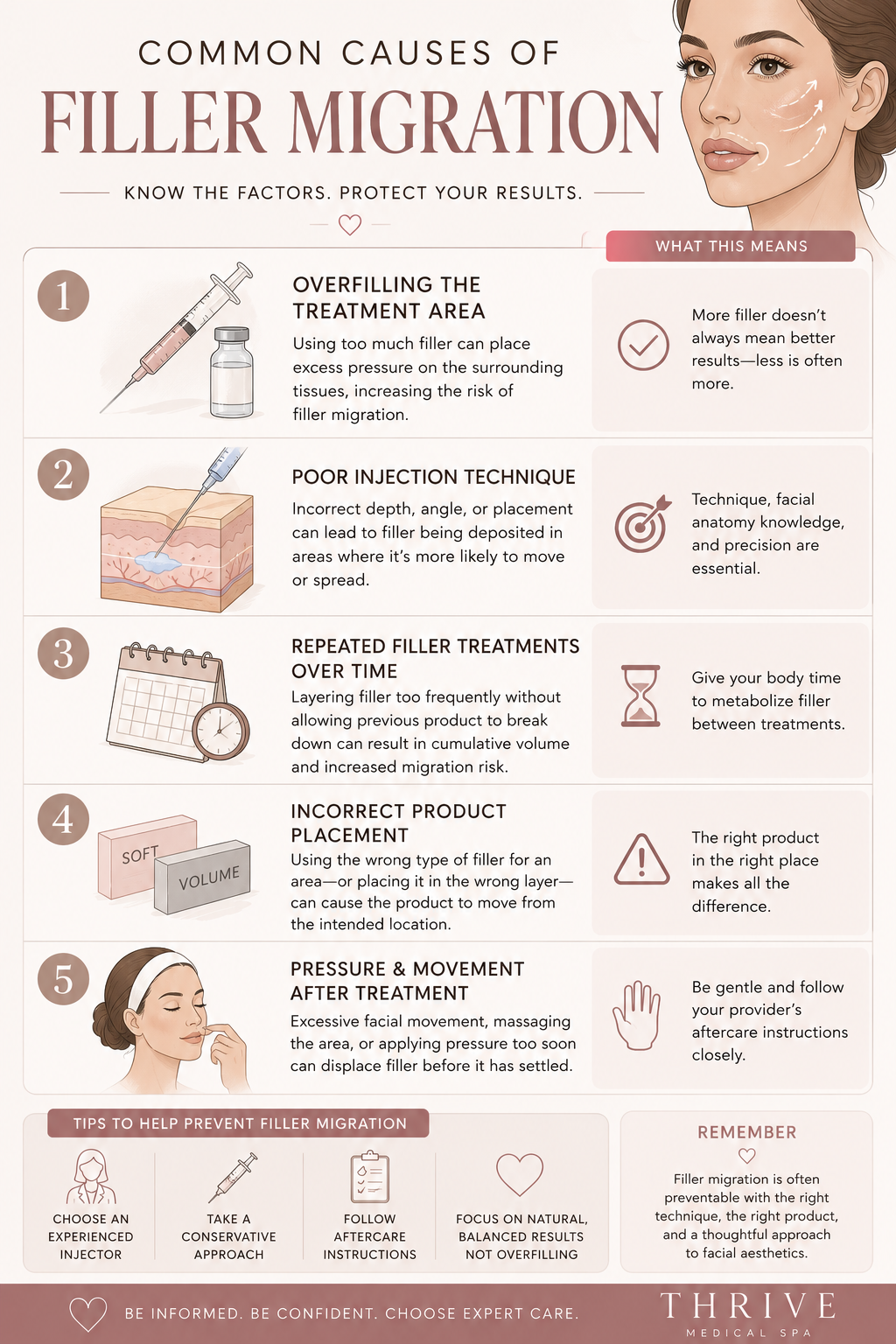
There is rarely a single cause of dermal filler migration. Instead, several factors often work together.
Overfilling the Treatment Area
One of the most common contributors to filler migration is simply using too much filler.
When excessive amounts of product are placed into a small area, the surrounding tissues may struggle to support the volume. Over time, the filler can spread beyond the intended borders.
This is particularly common in the lips, where repeated treatments can gradually create an overfilled appearance.
Poor Injection Technique
Poor injection technique is another significant factor.
Successful filler treatments require:
Detailed knowledge of facial anatomy
Proper injection depth
Appropriate product selection
Understanding tissue support
When filler is placed incorrectly, it may be more likely to migrate into adjacent tissues.
Repeated Filler Treatments Over Time
Even when individual treatments are performed appropriately, repeated filler treatments over many years can sometimes contribute to migration.
Some patients continually add filler without allowing previous product to fully break down. Over time, cumulative filler volume may increase the likelihood of migrated filler.
Incorrect Product Placement
Not every filler is appropriate for every area.
Some products are designed for structure and support, while others are intended for flexibility and movement.
Using the wrong filler for a particular area may contribute to filler migration because the product does not behave optimally within that tissue.
Pressure and Movement After Treatment
Although aftercare is rarely the sole cause of migration, excessive pressure shortly after treatment may potentially affect product placement.
Examples include:
Aggressive massage
Significant pressure on the treatment area
Certain facial treatments immediately after injections
This is one reason providers recommend following aftercare instructions carefully.
Where Does Filler Migration Usually Happen?
While filler migration happens in multiple areas, certain regions are more commonly affected.
Lip Filler Migration
Lip filler migration is by far the most frequently discussed form of migration.
Patients may notice filler extending beyond the natural lip border, particularly above the upper lip. This can create a "shelf" appearance or visible fullness above the lip rather than within the lip itself.
Lip filler migration often develops gradually over time rather than immediately after treatment.
Under-Eye Filler Migration
The under-eye area contains delicate tissues that can be more prone to swelling and filler movement.
Migrated filler in this region may appear as:
Puffiness
Persistent fullness
Bags beneath the eyes
Because under-eye anatomy is complex, treatment requires advanced injector experience.
Cheek and Midface Filler Migration
Migration within the cheeks and midface is less common but can occur.
Patients may notice:
Blurred facial contours
Excessive fullness
Loss of natural cheek definition
Again, this is often associated with excessive product placement or repeated treatments over time.
Signs and Symptoms of Filler Migration
Puffiness Outside the Intended Area
One of the most common signs is fullness extending beyond the original treatment location.
For example:
Puffiness above the lip
Swelling beneath the eyes
Fullness outside intended cheek contours
Blurred or Distorted Facial Contours
Well-performed filler should enhance facial esthetics while maintaining natural structure.
When migration occurs, facial contours may appear less defined or distorted.
Lumps or Uneven Texture
Migrated filler may occasionally create areas of uneven texture or localized fullness.
Not all lumps represent migration, however. Some lumps may be related to swelling, product integration, or normal healing.
An Overfilled or Unnatural Appearance
One of the most recognizable signs of filler migration is an unnatural appearance.
Patients may feel that:
Features look larger than intended
Facial proportions appear imbalanced
Results no longer reflect natural beauty
This is often where the concept of "too much filler" becomes relevant.
Filler Migration vs. Normal Swelling
Many patients worry about migration immediately after treatment when they are actually experiencing normal healing.
What Early Swelling Looks Like
Following filler injections, temporary swelling is completely normal.
Patients may experience:
Puffiness
Tenderness
Mild asymmetry
Firmness
These effects are typically temporary and improve during the first one to two weeks.
When Symptoms May Indicate Migration
Migration is generally not diagnosed immediately after treatment.
Persistent fullness that remains after healing, especially outside the intended treatment area, may warrant evaluation by an experienced injector.
Can Filler Migration Go Away on Its Own?
In some situations, migrated filler may improve gradually as the body naturally breaks down hyaluronic acid.
However, this process may take months or even years depending on:
Product type
Amount of filler
Individual metabolism
Patients who are bothered by the appearance often seek treatment rather than waiting for natural degradation.
How Is Filler Migration Treated?
Fortunately, several treatment options exist.
Dissolving Filler with Hyaluronidase
The most common treatment for hyaluronic acid fillers involves hyaluronidase.
Hyaluronidase is an enzyme that breaks down hyaluronic acid and can effectively dissolve unwanted filler.
This approach is often used for:
Lip filler migration
Under-eye migration
Overfilled areas
Asymmetries
Waiting for Filler to Naturally Break Down
Some patients choose to simply allow filler to metabolize naturally over time.
This may be appropriate when:
Migration is mild
Symptoms are not bothersome
The filler is already beginning to fade
Corrective Filler Treatments
In some cases, corrective filler treatments may help restore balance after migration has been addressed.
The goal is not necessarily more filler, but rather strategic placement that supports facial harmony.
How to Prevent Filler Migration
Choose an Experienced Injector
The most important step to prevent filler migration is choosing an experienced injector who understands facial anatomy and product selection.
Provider expertise remains one of the strongest predictors of successful outcomes.
Take a Conservative Approach
Conservative treatment plans often produce the most beautiful results.
Gradual enhancement allows the tissues to adapt while minimizing the risk of excessive volume.
Follow Proper Aftercare Instructions
Following your provider's instructions helps support optimal healing.
While aftercare alone does not determine outcomes, it remains an important part of treatment success.
Avoid Chasing Overfilled Trends
Social media trends often promote exaggerated results that do not align with long-term facial esthetics.
Natural looking results tend to age better and require less correction over time.
Why Less Filler Often Creates Better Results
One of the biggest shifts in modern aesthetics is the movement toward thoughtful, conservative treatment.
Many patients assume more filler automatically creates better results. In reality, strategic placement and moderation often create the most attractive outcomes.
Beautiful facial esthetics are typically achieved through:
Balance
Proportion
Harmony
Respect for natural anatomy
The goal should be enhancement, not transformation.
Final Thoughts
Filler migration is a real phenomenon, but it is often preventable. Understanding the causes, symptoms, and treatment options allows patients to make informed decisions about their aesthetic care.
The best way to minimize risk is to choose an experienced injector, prioritize natural results, and avoid excessive treatment. When filler migration does occur, effective treatment options are often available.
Looking for One-on-One Filler Advice? Schedule Your Cincinnati Consultation Today
If you have concerns about filler migration, previous filler treatments, or achieving natural-looking results, our team would love to help. During your Cincinnati Dermal Filler consultation, we'll evaluate your facial anatomy, discuss your goals, and create a personalized treatment plan designed to support long-term facial harmony.
About Thrive Medical Spa
Thrive Medical Spa is a premier aesthetic and wellness destination in Cincinnati, Ohio. We specialize in facial balancing, dermal fillers, collagen stimulation, medical-grade skincare, and natural-looking aesthetic treatments. Our philosophy centers on thoughtful treatment planning, individualized care, and results that enhance confidence while preserving natural beauty.
Frequently Asked Questions (FAQs)
What is filler migration?
Filler migration refers to filler material moving beyond the area where it was originally injected. When filler migration occurs, patients may notice fullness, puffiness, or contour changes outside the intended treatment area.
What causes filler migration?
Several factors can contribute to filler migration, including too much filler, poor injection technique, repeated filler treatments, incorrect product selection, and improper placement. Often, multiple factors work together rather than a single cause.
What does filler migration look like?
Filler migration often looks like puffiness, blurred facial contours, uneven fullness, or volume extending beyond the intended area. Lip filler migration may create fullness above the upper lip, while under-eye migration may appear as persistent puffiness.
How common is filler migration?
Significant dermal filler migration is not considered common when treatments are performed appropriately. However, awareness of migrated filler has increased as cosmetic fillers have become more widely used.
Is filler migration permanent?
No, filler migration is usually not permanent. Hyaluronic acid fillers can often be dissolved with hyaluronidase or may gradually break down naturally over time.
How can you avoid an overfilled appearance?
The best way to avoid an overfilled appearance is to take a conservative approach, choose an experienced injector, and focus on facial harmony rather than volume alone. Less filler often creates more natural and elegant results.